Soviet weightlifters in international competitions
Results of the Friendship-84 International Competitions
English summary of Tyazhelaya Atletika. Ezhegodnik 1985 (Moscow: Fizkultura i Sport, 1985), pp. 12–16: the text is paraphrased, not translated; data tables are given in full with English labels; figures are the original images.
At the 1976 and 1980 Olympic Games and at the Friendship-84 international competitions, Soviet weightlifters won 17 gold and 9 silver medals. This rests on mass participation, modern specialised halls, many coaches and a scientifically grounded system of preparation. The USSR has over 3,000 Masters of Sport and about 100 of international class, and in the past four years more than 2,500 athletes earned the Master standard for the first time and over 100 the international-class standard (Table 1). Growth is fastest among those who reach it before age 20, the source of most national team candidates.
Table 1. Development of weightlifting in the USSR, 1981–1984
| Indicator | Year | |||
| 1981 | 1982 | 1983 | 1984 | |
| Number of weightlifters | 332,030 | 330,901 | 339,382 | 349,254 |
| Number training in children's and youth sports schools and Olympic reserve schools | 40,914 | 40,713 | 46,309 | 53,362 |
| Number of coaches | 2,573 | 2,840 | 2,836 | 3,038 |
| Number of specialised halls | 1,393 | 1,191 | 1,221 | 1,262 |
| Earning the Master of Sport standard for the first time | 633 | 612 | 592 | 456 |
| Earning and confirming the international-class Master of Sport standard | 40 | 78 | 89 | 73 |
The last two Olympic cycles (1977–1980, 1981–1984) confirmed the USSR and Bulgaria as the strongest teams, with Hungary, the GDR, Cuba, the DPRK, Poland and Czechoslovakia strong in some classes. In 1984 world records in the total belonged to Soviet lifters in five of the ten classes, to Bulgarians in four and to an East German in one, and the world's top ten shows a clear Soviet edge, especially in heavy classes. Soviet weightlifting shows rising results, more youth-school pupils, better facilities and a younger contingent. The team's success also owed much to fulfilling the master plan for Olympic preparation and individual plans, and to coaches working with the scientific group.
In this cycle the national team's loads rose markedly and a single planning system was introduced; the planned annual volume grew from 18,000 to 24,000 lifts, including over 600 lifts at 90% or above. Preparation aimed at the XXIII Olympic Games, but because of the US administration's anti-Olympic stance and violations of the Olympic Charter, Soviet and other socialist-country athletes could not take part, which affected results. Table 2 shows that in several classes even bronze medallists at Friendship-84 beat the Olympic champions. Of 30 world records broken there, 18 were Soviet and 12 Bulgarian.
Table 2. Totals of the medallists at Friendship-84 and at the XXIII Olympic Games (kg)
| Competition | Place | Weight class, kg | |||||||||
| 52 | 56 | 60 | 67.5 | 75 | 82.5 | 90 | 100 | 110 | Over 110 | ||
| XXIII Olympic Games | 1st | 235 | 267.5 | 282.5 | 320 | 340 | 350 | 392.5 | 385 | 390 | 412.5 |
| 2nd | 235 | 265 | 280 | 312.5 | 335 | 342.5 | 360 | 382.5 | 380 | 410 | |
| 3rd | 232.5 | 252.5 | 272.5 | 312.5 | 332.5 | 340 | 352.5 | 367.5 | 377.5 | 397.5 | |
| Friendship-84 international competitions | 1st | 252.5 | 297.5 | 322.5* | 337.5 | 377.5* | 405* | 422.5* | 427.5 | 442.5* | 465 |
| 2nd | 232.5 | 295 | 315 | 335 | 362.5 | 385 | 400 | 390 | 427.5 | 462.5 | |
| 3rd | 232.5 | 230 | 295 | 315 | 340 | 370 | 375 | 385 | 412.5 | 415 | |
* World record in the total. As printed (including 230 at 56 kg, 3rd).
Both teams were renewed. Of the XXII Olympic Games participants only Yu. Sarkisyan, Yu. Vardanyan and L. Taranenko remained on the Soviet team, which was 70% new, with an average age of 24. Bulgaria fielded three 1980 medallists (Ya. Rusev, A. Zlatev, B. Blagoev) and averaged 22. Since those Games totals have risen in every class by 7.5 to 45.0 kg (except at 67.5 kg). In most classes (56 to 90 kg, except 52 and 100) the two teams were practically level in physical, technical and psychological preparation, and tactics decided the outcome.
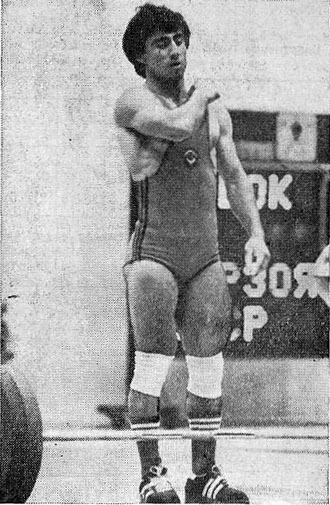
The USSR had no one at 52 kg. The Bulgarian N. Terziyski won by 20 kg with 252.5,, with B. Pikorz (Poland) and B. Olah (Hungary) next. At 56 kg N. Suleymanov (Bulgaria) and O. Mirzoyan (USSR) both snatched 132.5 kg, 1 kg over the world record, and in an extra attempt Mirzoyan made it 133. Suleymanov was lighter, so Mirzoyan needed a jerk 2.5 kg heavier. They opened with 165 and 162.5 kg and both tried a record 170.5; Suleymanov made it in an extra attempt, totalling 297.5 kg to Mirzoyan's 295.
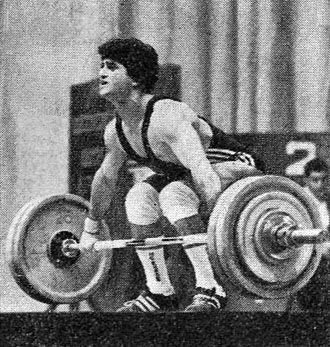
At 60 kg Yu. Sarkisyan, lighter than S. Topurov but heavier than A. Kodzhabashev, opened the snatch with 135 kg after the two Bulgarians had made 130 and 132.5. A mistimed pull cost him a record try, and though he then lifted 140 kg, the record went to Topurov, who reached it first. Sarkisyan made only 175 kg in the jerk, on his third attempt, after errors driving the bar from the chest. Topurov set world records of 182.5 and 185 kg and a record total of 322.5 kg; Sarkisyan totalled 315 kg and Kodzhabashev 295.
At 67.5 kg Bulgaria fielded Ya. Rusev and A. Varbanov, and V. Grachev competed for the USSR individually. Both Bulgarians snatched 145 kg, Grachev 152.5, but 157.5 kg, over the world record, eluded him twice. In the jerk the Bulgarians were clearly stronger: Grachev 182.5 kg, Rusev 192.5 and Varbanov, in an extra attempt, a world record 200. Totals: Rusev 337.5 kg, Varbanov and Grachev 335 each.
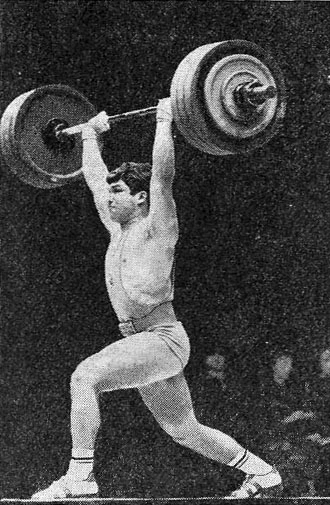
The coaches counted on the world snatch record holder V. Kuznetsov (75 kg), but he was unsure in the snatch, making 162.5 kg only on his second attempt and missing 170 (2.5 kg over the record); Z. Stoichkov made 167.5 and led. In the jerk Kuznetsov lifted 200 kg and Stoichkov 202.5, then 207.5 and 210, for a world-record total of 377.5 kg. The lighter Kuznetsov needed 215 kg to win but was not ready physically or psychologically and failed twice. Stoichkov added a world record 211 kg in an extra attempt.
After five classes Bulgaria had 5 golds, 1 silver and 1 bronze, the USSR three silvers. The turn came with Yu. Vardanyan at 82.5 kg, who set world records of 182.5 kg in the snatch, 224 in the clean and jerk and 405 in the total. A. Khrapaty, competing individually, also set records (snatch 181 kg, total 402.5), while A. Zlatev managed only 385 kg. At 90 kg V. Solodov won with world records of 233 kg (jerk) and 422.5 (total), 22.5 kg ahead of B. Blagoev. Bulgaria had no entry at 100 kg. P. Kuznetsov led, but lack of competition and the tactical fight for team places held him back; he set only one record, 241.5 kg in the jerk. His 427.5 kg beat A. Shanai (Hungary), 390, and M. Chernik (Czechoslovakia), 385.
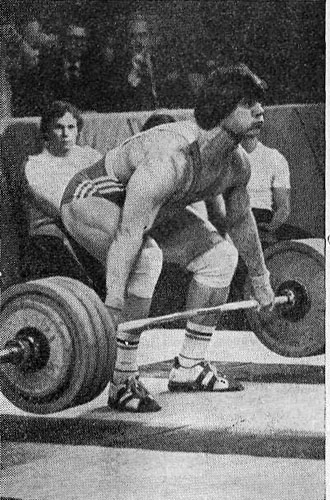
At 110 kg three Soviet and two Bulgarian lifters fought: L. Taranenko and Yu. Zakharevich for the USSR, V. Kravchuk individually; Ya. Georgiev for Bulgaria, V. Osikovsky individually. Zakharevich set a snatch record of 197.5 kg, Taranenko answered with 200 and Zakharevich made 200.5 in an extra attempt. In the jerk both Soviet lifters opened with 230 kg and Taranenko went on to 242.5. Zakharevich skipped it and failed twice at 245, evidently not yet psychologically recovered from an elbow operation. Taranenko totalled a world-record 442.5 kg, Zakharevich 427.5 and Georgiev 412.5. Soviet lifters also took first and second among the superheavyweights, with R. Skolimowski (Poland) third on 415 kg. The USSR finished with 5 golds and 5 silvers, Bulgaria with 5 and 3.
Table 3. Reliability of Bulgarian and Soviet lifters at Friendship-84 (% of attempts made)
| Bulgarian lifters | Soviet lifters | ||||||
| Lifter, weight class | Snatch | Clean and jerk | Total | Lifter, weight class | Snatch | Clean and jerk | Total |
| N. Terziyski, 52 | 57 | 33 | 50 | O. Mirzoyan, 56 | 100 | 30 | 67 |
| N. Suleymanov, 56 | 100 | 33 | 67 | Yu. Sarkisyan, 60 | 67 | 33 | 50 |
| S. Topurov, 60 | 100 | 67 | 83 | V. Kuznetsov, 75 | 33 | 33 | 33 |
| A. Kodzhabashev, 60 | 33 | 67 | 50 | Yu. Vardanyan, 82.5 | 100 | 100 | 100 |
| Ya. Rusev, 67.5 | 67 | 100 | 83 | V. Solodov, 90 | 67 | 100 | 83 |
| A. Varbanov, 67.5 | 67 | 67 | 67 | P. Kuznetsov, 100 | 67 | 67 | 67 |
| Z. Stoichkov, 75 | 100 | 100 | 100 | L. Taranenko, 110 | 100 | 67 | 83 |
| A. Zlatev, 82.5 | 67 | 33 | 50 | Yu. Zakharevich, 110 | 67 | 33 | 50 |
| B. Blagoev, 90 | 33 | 67 | 50 | ||||
| Ya. Georgiev, 110 | 33 | 100 | 67 | ||||
| Team average | 66 | 67 | 67 | 75 | 58 | 66 | |
Table 3 shows Soviet lifters more reliable in the snatch (75%), but Bulgarians in the clean and jerk (67% against 58%), suggesting that Bulgarian preparation gives that lift more attention. To raise reliability, light-class lifters (52–75 kg) need more lifts at 90–100% (jerk from the chest) just before major competitions, and nobody should exceed the class limit by more than 3–4 kg.
Overall, high results owed much to a purposeful system of preparing candidates, but not all realised their potential. The main shortcomings lie in psychological preparation, weight-cutting methods and the jerk from the chest. Another acute problem is the thin supply of light-class lifters (52–75 kg), blamed on sports organisations and coaches in the republics, trade-union societies and departments for not selecting and training short athletes purposefully.