Equipment and training apparatus
A Device for Correcting the Barbell Path from the Start
English summary of Tyazhelaya Atletika. Ezhegodnik 1985 (Moscow: Fizkultura i Sport, 1985), pp. 53–54: the text is paraphrased, not translated; figures are the original images.
The hardest thing to correct in the classic lifts is the direction in which the bar leaves the floor. Skilled lifters shorten the lever arm of the resistance by drawing the bar back up to 40 mm as it rises to knee level (Druzhinin, 1965; Roman, 1976); beginners send it forward, probably from fear of catching their shins and knees. Watching by eye achieves little, and instrumental methods (Druzhinin, 1965; Komar, 1982; Cherkesov, 1974) are rare. The device proposed here (Fig. 1) teaches the start of the pull and prevents early errors.
The trajectory template (1) leans back slightly, by 15–20 mm, as is typical of beginners, and its uprights are 70 mm apart. It is hinged to the base (2) and held by elastic ties, so the bar may deviate backward (better-qualified lifters) or forward (beginners). Moving the pivot into another hole of the base strips changes the model amplitude. A display panel (3) stands 2–3 m in front of the athlete, with a white and a red lamp on its face and the power source behind.
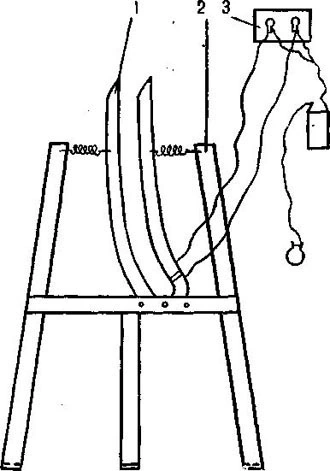
If the bar rises vertically while moving forward, the red lamp lights, as a poor attempt in judging. If it moves back exactly along the template, no lamp lights; if further back than the template allows, the white lamp lights, the best outcome. A lift without touching the uprights is good, not average, since the lifter has learned to bring the bar back along a curve. At first the size of the backward shift is unimportant, depending on arm-to-trunk muscle strength, build and the balance of trunk and leg muscles; later it is increased gradually to the optimum, and the heavier the weight, the smaller it is.
For the signalling, the aluminium tube of the template is sawn through and a dielectric rod inserted, separating the circuits of the front and rear uprights. The power source is wired to the sleeve by a quick-release clamp, and a second wire splits to the uprights. Soft metal such as aluminium is preferred for joints, so a dropped bar does not deform them.
Before use, check that the bar cannot roll on the platform; if it can, put wooden strips 5–10 mm thick under the plates. Place the device at the end of the bar, with the sleeve centred between the uprights. Remind the athlete that a red lamp means drawing the bar back more. Afterwards, assess the work and advise.